
Celebrating Excellence in Immunization Program Management
AIM recognizes that immunization program managers are central to the success of our nation’s immunization efforts. AIM members ensure vaccines reach the thousands of providers who provide COVID-19 vaccination and the 44,000+ providers and physicians enrolled in the Vaccines for Children program. Members do the hard and necessary work to lead the nation’s network of immunization programs—supporting information systems that track vaccinations, monitoring vaccination progress, containing outbreaks, and informing and educating consumers. They work year-round to develop and implement strategies to ensure that immunization coverage rates remain high, and that babies, adolescents, and adults are protected from vaccine-preventable disease.
AIM is proud to celebrate the hard work, innovation, and commitment to excellence shown by program managers throughout the nation.

The Natalie J. Smith, MD Award is presented in memory of AIM member Natalie J. Smith’s outstanding management and leadership skills. It was established to recognize the contributions of an immunization program manager who has demonstrated the high ideals, innovation, and commitment to excellence in immunization practices that characterized Dr. Smith’s career. The award recognizes accomplishments and visionary leadership that have had a significant impact on achieving city, state, territory, and/or national vaccine-preventable disease goals and is the highest form of recognition for immunization program managers.
2025 Natalie J. Smith, MD Award Nomination and Submission Processes
Please view the items below for more information on the nomination and submission processes for the 2025 Natalie J. Smith, MD Award.
Previous Natalie J. Smith, MD Award Recipients
- 2004 – Lorraine Duncan (OR)
- 2005 – Alice Gray (PA)
- 2006 – Beth Rowe-West (NC)
- 2007 – Laurel Wood (AK)
- 2008 – Mike Chaney (GA)
- 2009 – Greg Reed (MD)
- 2010 – Janna Bardi (WA)
- 2011 – Susan Lett (MA)
- 2012 – Kelly Moore (TN)
- 2013 – Vincent Sacco (CT)
- 2015 – Jane Zucker (NYC)
- 2016 – Bob Swanson (MI)
- 2017 – Pejman Talebian (MA)
- 2018 – Annette Aguon (GU)
- 2019 – Christine Finley (VT)
- 2022 – Molly Howell (ND)
- 2023 – Michele Roberts (WA)
2024 Winner: Ron Balajadia, MS, Immunization Branch Chief, Immunization Branch, Hawai’i Department of Health
This year’s winner, Ron Balajadia, MS, is a passionate leader in the AIM community and also a 2024 inductee into the AIM Hall of Fame. He previously received the AIM Impact Award and has served in various leadership positions over the past 20 years including AIM Chair, Secretary-Treasurer, and multiple terms on the Executive Committee. Ron’s accomplishments in his home state include establishing a statewide school-located vaccination program, HPV school requirement, and a comprehensive pandemic vaccination program involving more than 150 partners from over 90 organizations. As a longtime AIM member, Ron has worked diligently to build a strong community for the Pacific Islands and remains a consistent and vocal champion for Pacific Island programs and the unique challenges they face.
The AIM Rising Star Award recognizes a new program manager who demonstrates effective leadership and potential for growth within AIM. Awardees are engaged with peers and partners across the country and demonstrate a desire to impact the broader immunization community.
2025 AIM Rising Star Award Nomination and Submission Processes
Please view the items below to find more information on the nomination and submission processes for the 2025 AIM Rising Star Award.
Previous AIM Rising Star Award Recipients
- 2016 – Michele Roberts (WA)
- 2017 – Dr. Sarah Royce (CA)
- 2018 – Shannon Bennett (NV)
- 2019- Tom McCleaf (PA)
- 2022 – Emily Messerli (KY)
- 2023 – Heather Burris (DC)
2024 Winner: Emman Parian, MPH, Immunization Program Manager, Commonwealth Healthcare Corporation, Division of Public Health Services, Northern Mariana Islands
Emman Parian, MPH, the program manager in the Commonwealth of the Northern Mariana Islands, is a member of the AIM Executive Committee, serves as co-chair of the AIM Adult Immunization Committee, and is a member of the 2024 AIM Conference Planning committee. He regularly attends the AIM U.S. Affiliated Pacific Islands (USAPI) monthly calls, has shared his program’s work and lessons learned in the AIM Quarterly Peek, and was a speaker on vaccine confidence for an AIM educational webinar.
2024 Winner: Merideth Plumpton, RN, Immunization Program Manager, Vermont Department of Health
Merideth Plumpton, the program manager in Vermont, is a member of the AIM Member Engagement Committee, a regular attendee of AIM Member Meetups, and was a featured speaker on an AIM roundtable discussing financing for the Vermont adult immunization program. Merideth also featured her programmatic lessons learned in a volume of the Quarterly Peek.
The AIM Partnership Award recognizes an AIM partner who has worked with AIM to address an issue important to AIM members. Award winners’ work must involve collaboration and shared responsibility with AIM to implement a project that delivers a valuable resource or service to AIM members. Past award winners have been from academic institutions, nonprofits, government, academic institutions, the public health community, and the private sector.
Previous Partnership Award Recipients
- 2017 – Melinda Wharton, Director of the Immunization Services Division, National Center for Immunization and Respiratory Diseases, Centers for Disease Control and Prevention
- 2018 – Amy Pisani, Every Child by Two
- 2019 – Laurel Wood, Immunization Action Coalition
- 2022 – Chris Duggar, Senior Public Health Advisor and COVID Unit Lead, Immunization Services Division, Centers for Disease Control and Prevention
- 2023 – Nathan Crawford, Awardee Coordination and Support Team Lead, Immunization Operations and Services Branch, Centers for Disease Control and Prevention
2024 Winner: American Immunization Registry Association (AIRA)
This year’s winner, AIRA, has been integral to immunization programs in supporting their use of immunization information systems (IIS) and continuing the advancement of the nation’s leading public health information infrastructure. Founded in 1999, AIRA serves the IIS community and works tirelessly to bring the IIS and program manager communities together. AIRA’s work to improve the quality and use of data and data systems has improved immunization program management and vaccination coverage rates across the lifespan. With AIRA and AIM advocating collectively for the advancement of IIS and immunization, we are stronger, more powerful, and more influential. AIRA continues to foster collaboration among IIS and immunization programs, organizations, communities, and public health professionals and provides valuable resources to all immunization programs and partners.
The Bull’s-Eye Award for Innovation and Excellence in Immunization recognizes programs whose immunization strategies have “hit their mark,” achieving goals and increasing awareness by encouraging replication in other programs. This award is presented annually to three state, territorial, or urban area immunization programs (awardees) in recognition of an outstanding immunization initiative.
2025 Bull’s-Eye Award Winners
Maine Department of Health and Human Services for their initiative Docket for Schools
Washington State Department of Health Office of Immunizations for their initiative The HPV @ 9 Quality Improvement (QI) Project
Minnesota Department of Health for their initiative Becoming a Vaccine Advocate Training Program
2024 Bull’s-Eye Award Winners
Colorado Department of Public Health and Environment for their initiative Immunization Public Health Detailing: An Innovative Approach to Improving Vaccination Coverage
Indiana Department of Health Immunization Division for their initiative Thinking Outside the Box – Pharmacies as VFC Providers
Virginia Department of Health Division of Immunization for their initiative Virginia Vaccines for Children (VVFC)
The AIM Impact Award recognizes a program manager who has dedicated significant time, expertise, and experience toward achieving AIM’s organizational goals—such as fostering member connection and contributing to sound immunization policy.
Previous AIM Impact Award Recipients
- 2016 – Ronald Balajadia (HI)
- 2017 – Dave McCormick (IN)
- 2018 – Michele Roberts (WA)
- 2019 – Molly Howell (ND)
- 2022 – Michele Roberts (WA)
- 2023 – Amber Tirmal (Phila)
2024 Winners: Sarah Leeds, MPH, Immunization Program Manager, Idaho Department of Health and Welfare and Dave McCormick, Immunization Division Director, Indiana Department of Health
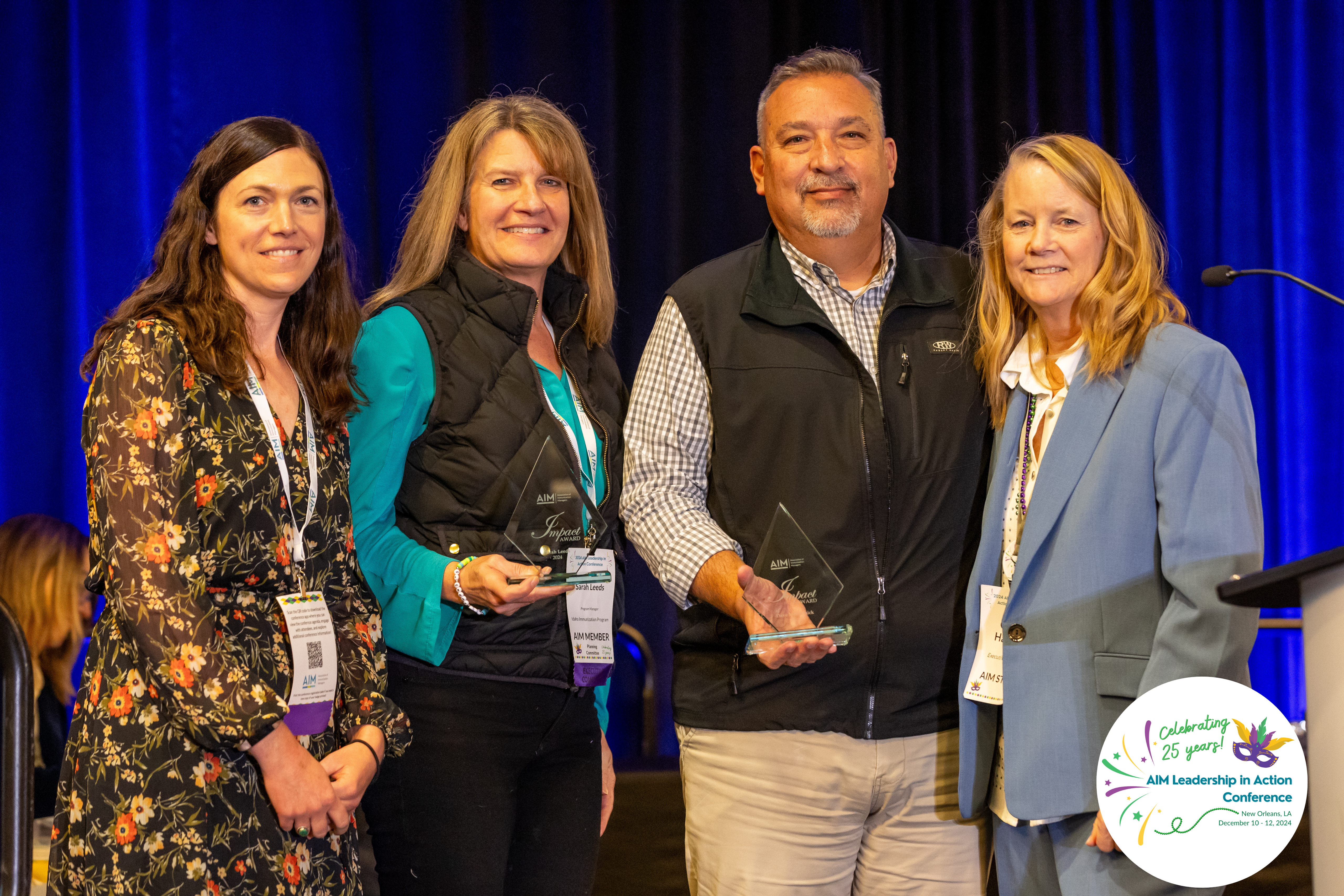
Sarah Leeds has served on numerous committees, including the Executive Committee, Health Equity Committee, Member Engagement Committee, and the Conference Planning Committee. She also participated in the American Academy of Pediatrics (AAP) Working Group. Sarah also serves as an AIM Peer Connect mentor and continues to answer many calls to help and support the AIM organization and their fellow program managers.
Dave McCormick has served on multiple AIM committees including the Adult Immunization Committee and the Conference Planning Committee. He has participated in the CDC VFC Listening Session and the AIM Emerging Issues Summit. Dave also serves as an AIM Peer Connect mentor to new members and has shared his programmatic wisdom and lessons learned in the Program Manager Knowledge Hub. Dave is a true leader for program managers in his region and beyond.
The AIM Leading Through Adversity Award recognizes program managers who have shown fearlessness and perseverance under pressure and have risen to the challenge of managing an immunization program through difficult circumstances.
Previous AIM Leading Through Adversity Award Recipients
- 2022 – All AIM Members Working During the COVID-19 Pandemic
2023 Winners: All AIM Members
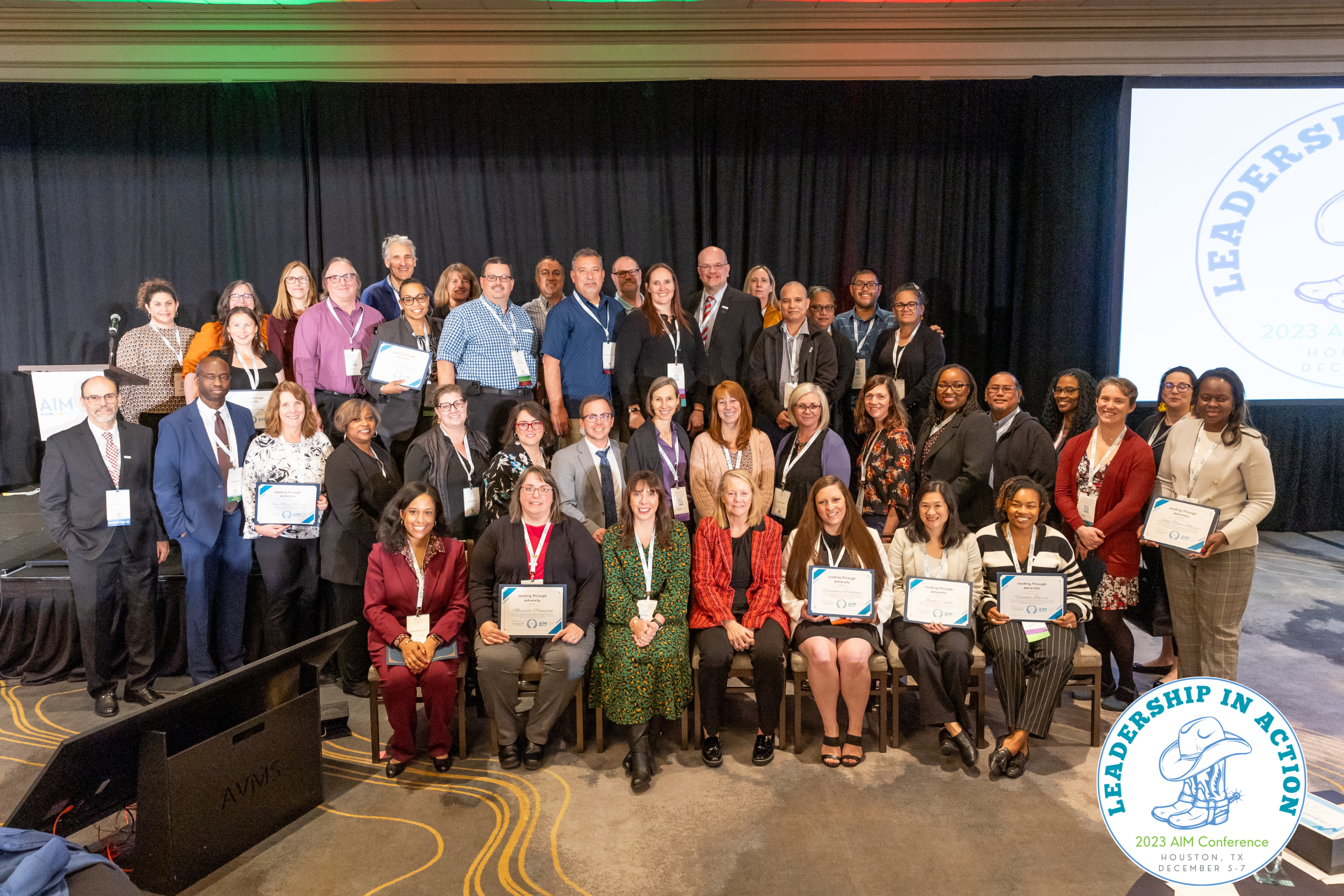
This year, AIM awards all immunization program managers and thanks them for their extraordinary efforts.
AIM’s Hall of Fame Award recognizes an individual’s leadership, commitment, and outstanding contributions to the immunization program manager community and the vision of a nation free of vaccine-preventable disease.
AIM is no longer accepting nominations for the 2025 Hall of Fame
Previous AIM Hall of Fame Inductees
- 2022: Brock Lamont, Retired CDC Chief, Immunization Services Division, Program Operations Branch
- 2023: Dan Hopfensperger, Retired Wisconsin Immunization Program Manager, Former AIM Consultant
- 2024:
- Ron Balajadia, Immunization Branch Chief, Immunization Branch, Hawai’i Department of Health
- Pejman Talebian, Immunization Division Director, Massachusetts Department of Public Health
- Beth Rowe-West, Retired Immunization Program Manager, North Carolina Department of Health and Human Services
- Laurel Wood, Retired Immunization Program Manager, Alaska Division of Public Health
- Jane Zucker, Retired Assistant Commissioner, New York City Department of Health and Mental Hygiene, Bureau of Immunization
2025 Inductee: David Lynch, Retired Assistant Director, New York State Department of Health, Bureau of Immunization

David Lynch was the program manager in New York State, a founding member of AIM, and served as AIM Chair in 2000. He continued to be an active AIM member until his retirement from New York State. As part of AIM’s first Executive Committee, he was responsible for securing a pro bono law firm to draft the AIM bylaws and obtain its 501(c)(3) status. David worked tirelessly to get AIM launched and to build a relationship between AIM and the Centers for Disease Control and Prevention (CDC), resulting in AIM receiving cooperative agreement funding from CDC.
2025 Inductee: Greg Reed, MPA, Current Senior CDC Public Health Advisor and Former Chief, Center for Immunization, Maryland Department of Health

Greg Reed is the senior public health advisor for the Maryland immunization program. He also was the Maryland immunization program chief from 2000-2018 and served on the AIM Executive Committee. Greg was part of the initial formation of AIM and served on the selection committee for AIM’s first Executive Director. He played an active role in the early AIM Strategic Plan meetings and supported the growth of AIM through his inception of the AIM Business Reception. Additionally, Greg worked with AIM staff to plan and host the first AIM Leadership in Action Conference in 2016. He chaired the AIM Conference Planning Committee for several years, ensuring a successful annual conference which supported the needs for program managers. In 2009, Greg received the Natalie J. Smith, MD Award for Excellence in Program Management.
2025 Inductee: Natalie J. Smith, MD, MPH Retired Deputy Director of the National Immunization Program for Centers for Disease Control and Prevention (CDC) and Former Chief of Immunization Branch, California Department of Public Health
Throughout her career, Natalie J. Smith, MD, made critical scientific contributions that supported national immunization programs’ successful administration of smallpox, measles, mumps, rubella, and Hepatitis A vaccinations. She played a prominent role in bioterrorism issues and worked on numerous immunization-related issues with several organizations, such as the American Medical Association and the Institute of Medicine. Children and adults’ protection from vaccine-preventable diseases is largely due to Dr. Smith’s outstanding contributions to the field of immunization. Dr. Smith was also a founder of the California Coalition for Childhood Immunizations. AIM established the Natalie J. Smith, MD Award in memory of Dr. Smith’s outstanding management and leadership skills. The award is presented annually to recognize the contributions of an immunization program manager who has demonstrated the high ideals, innovation, and commitment to excellence in immunization practices that characterized Dr. Smith’s career.
2025 Inductee: Robert (Bob) Swanson, MPH, Retired Director of the Division of Immunization, Michigan Department of Health and Human Services

Bob Swanson worked for the Michigan immunization program for nearly 33 years and spent 16 years as the director of the division of immunization. Bob served as the Chair of the AIM IIS Policy Committee, a member of the AIM Executive Committee, and an AIM mentor. In 2016, Bob also received the Natalie J. Smith, MD Award for Excellence in Program Management. His vision of using an immunization information system (IIS) to support all aspects of program management helped transform the growth of IIS. Bob spent many hours working with other program managers and AIM staff to help them understand the value of IIS and to develop their own jurisdictional IIS. Though he retired in 2021, Bob served as a voting member on the National Vaccine Advisory Committee until 2024.
2022 marked the inaugural reinstatement of the previously titled CDC Childhood Immunization Champion Award. Now hosted by AIM, the newly expanded and streamlined Immunization Champion Awards honor up to one Champion from each of the 50 states, six major cities, and eight territories and federated states.